
What Size Should a Casket Be? A Practical Guide to Length, Width, and HeightUpdated 18 days ago
When building a casket, the most important size constraint is usually not the person inside it.
It is the burial vault.
In the United States, a typical standard burial vault may provide only about 29 to 30 inches of inside width. That means the complete outside width of the casket—including the case, trim, handles, and hardware—must fit within that available space.
Length and height are usually much less restrictive. Width is where builders most often encounter problems.
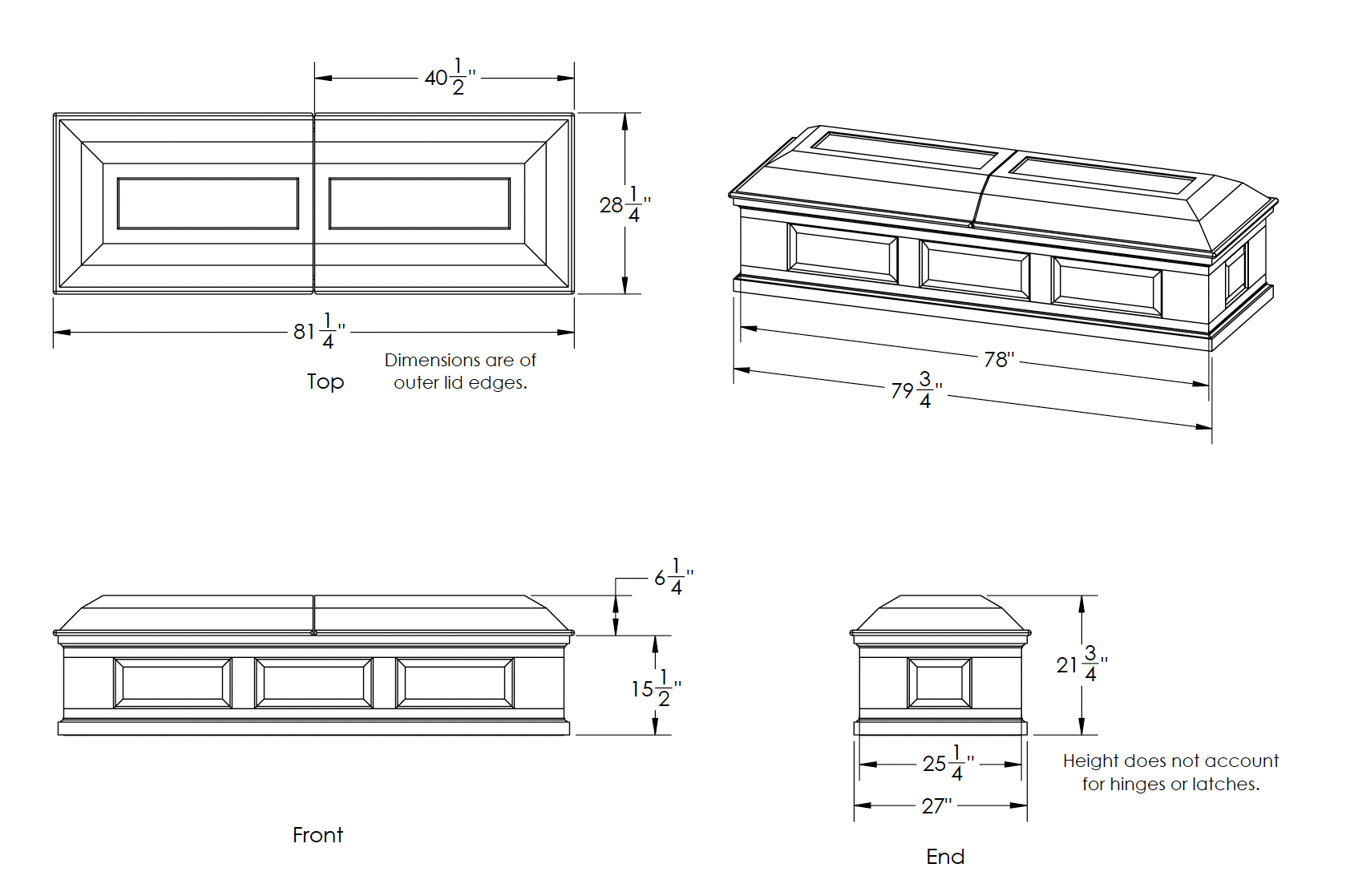 Typical conventional casket dimensions.
Start With the Burial Vault
A typical U.S. burial vault may provide approximately:
- 29–30 inches of inside width
- About 84 inches of inside length
- 30 inches or more of inside height
These are typical dimensions, not universal standards.
Some vaults may be only 28 inches wide, and smaller vaults in the 26-inch range also exist. Dimensions vary by vault manufacturer, cemetery, region, and country.
For that reason, the most important rule is:
Never assume the available burial-vault dimensions. Confirm them before building the casket.
Talk with the funeral director, cemetery operator, or cemeterian before beginning construction—especially if the casket will be wider than normal.
International requirements can be very different as well. For example, burial vaults used in Bermuda can be narrower than those commonly used in the United States.
Casket Length Is Usually Not the Limiting Dimension
Most adult caskets are approximately 78 to 82 inches long overall.
With many standard burial vaults providing around 84 inches of interior length, this usually leaves adequate clearance.
Naturally, an unusually tall individual may require additional interior length. The builder should also allow space for:
- Interior upholstery
- A pillow or head support
- Foot clearance
- Wall thickness
- The shape and construction of the head and foot panels
For most builds, however, vault length is not the primary design limitation.
Casket Height Is Usually Generous
Height is also rarely the first problem.
A typical wooden casket may be around 24 inches tall, while many burial vaults provide 30 inches or more of interior height.
Builders still need to consider:
- Domed or raised lids
- Decorative trim
- Exterior moldings
- Unusual lid construction
- Hardware that projects above the case
But in most conventional designs, there is considerably more flexibility in height than there is in width.
Width Is the Critical Dimension
The most important dimension to determine is the usable interior width of the casket.
Some simple casket designs provide only 21 to 22 inches of interior opening. That may be adequate for smaller individuals, but many adults require closer to 24 inches of usable interior width.
Larger individuals may require 25½ inches or more.
This is where the design problem becomes more difficult.
If you start with a 25½-inch interior opening, you still have to add:
- The thickness of the left sidewall
- The thickness of the right sidewall
- Exterior trim or moldings
- Handle hardware
- The amount the handles project away from the casket
It does not take much before the total outside width approaches—or exceeds—the approximately 30 inches available in many standard burial vaults.
Interior Width and Exterior Width Are Not the Same
This is one of the most important concepts for a first-time builder.
A casket might have a 24-inch inside opening, but the complete casket could be several inches wider once the walls and handles are included.
For example, the design sequence should be:
Required interior opening
→ add wall thickness
→ add trim and molding
→ add handle projection
→ determine final outside width
→ verify that width with the cemetery
Do not design the inside dimensions in isolation.
Handle Style Can Affect Overall Width
Handle selection is not purely decorative.
Stationary handles typically project farther from the side of the casket.
Swing-bar handles can usually fold closer to the casket body and therefore take up less space when the casket is placed into the burial vault.
On a normal-size casket, this difference may not matter much.
On a wide casket, it can become critical.
When every inch counts, handle style should be considered early in the design rather than added after the casket has already been built.
When Does a Casket Become “Oversized”?
Oversized is the commonly accepted industry term for caskets that exceed conventional dimensions.
In practical terms, once the required interior dimensions force the casket outside the limits of a standard burial vault, the entire burial arrangement may change.
An oversized casket may require:
- An oversized burial vault
- A wider grave opening
- Additional coordination with the cemetery
- Special transportation or handling
- In some cases, the use of two adjacent cemetery lots
Requirements vary considerably from one cemetery to another.
That is why an oversized casket should never be built without discussing the dimensions with both the funeral director and the cemetery first.
Do Not Simply Scale Up a Standard Casket
If a person requires a larger casket, it may be tempting to simply make a standard design wider.
That can create additional problems.
Increasing casket width can affect:
- Floor span
- Structural strength
- Handle loading
- Carrying difficulty
- Overall weight
- Lid geometry
- Lumber requirements
- Burial-vault compatibility
An oversized casket should therefore be treated as a separate structural design problem rather than simply a larger version of a standard casket.
A Good Rule for Casket Builders
When determining casket size, work from the inside out.
- Determine the interior space required for the person.
- Pay particular attention to the required interior width.
- Add the thickness of the casket walls.
- Add trim, moldings, and hardware.
- Consider how far the handles project.
- Calculate the complete outside dimensions.
- Confirm those dimensions with the funeral director and cemetery before construction begins.
The single most important principle is:
Determine the required inside dimensions first, but confirm the allowable outside dimensions before you build.
There is no universal casket size that fits every person, every vault, or every cemetery.
A few minutes spent confirming the burial requirements before construction can prevent a very serious problem later.